
Q3 2026 Market Commentary: Rising Rates, Bond Opportunities, and the AI Spending Boom
| Index | Q3 2026 | YTD 2026 |
|---|---|---|
| S&P 500 | 2.30% | 12.75% |
| Bloomberg U.S. Aggregate Bond Index | −3.51% | −2.91% |
Stocks and bonds moved in opposite directions in the third quarter. The S&P 500 returned 2.30% while the Bloomberg U.S. Aggregate Bond Index fell 3.51%. Two developments stand out as we head into year-end: sharply higher interest rates and an AI investment cycle of historic scale.
Higher rates are making borrowing more expensive for consumers and businesses, but they have also improved the opportunity set in fixed income. After years in which yields offered little compensation for risk, select segments of the bond market now look attractive. The central question for investors is how much interest-rate risk to assume while rates still have upward momentum.
The AI buildout is the other major force. The largest technology companies treat it as a race they cannot afford to lose, and their spending is largely detached from near-term returns. That spending supports economic growth and generates substantial profits for suppliers, but it is increasingly funded with debt, equity issuance, and complex financing arrangements. How much longer can investment keep growing at this pace, and what happens to the economy and corporate earnings when that growth slows?
Rising Yields: Drivers and Implications
The 10-year Treasury yield ended September at 5.29%, up from roughly 4.2% at the start of the year. Because the 10-year yield is a key benchmark for long-term borrowing costs, the increase has implications across the economy. For bondholders, the mechanics are straightforward: as newly issued bonds offer higher yields, the prices of existing bonds must decline to remain competitive. Longer-dated bonds are especially sensitive, and long-term Treasuries fell nearly 9% during the quarter.1,2
As the following chart illustrates, the 10-year Treasury yield bottomed near the end of February, shortly before the war with Iran began. Yields have since moved materially higher, with the advance accelerating in September.
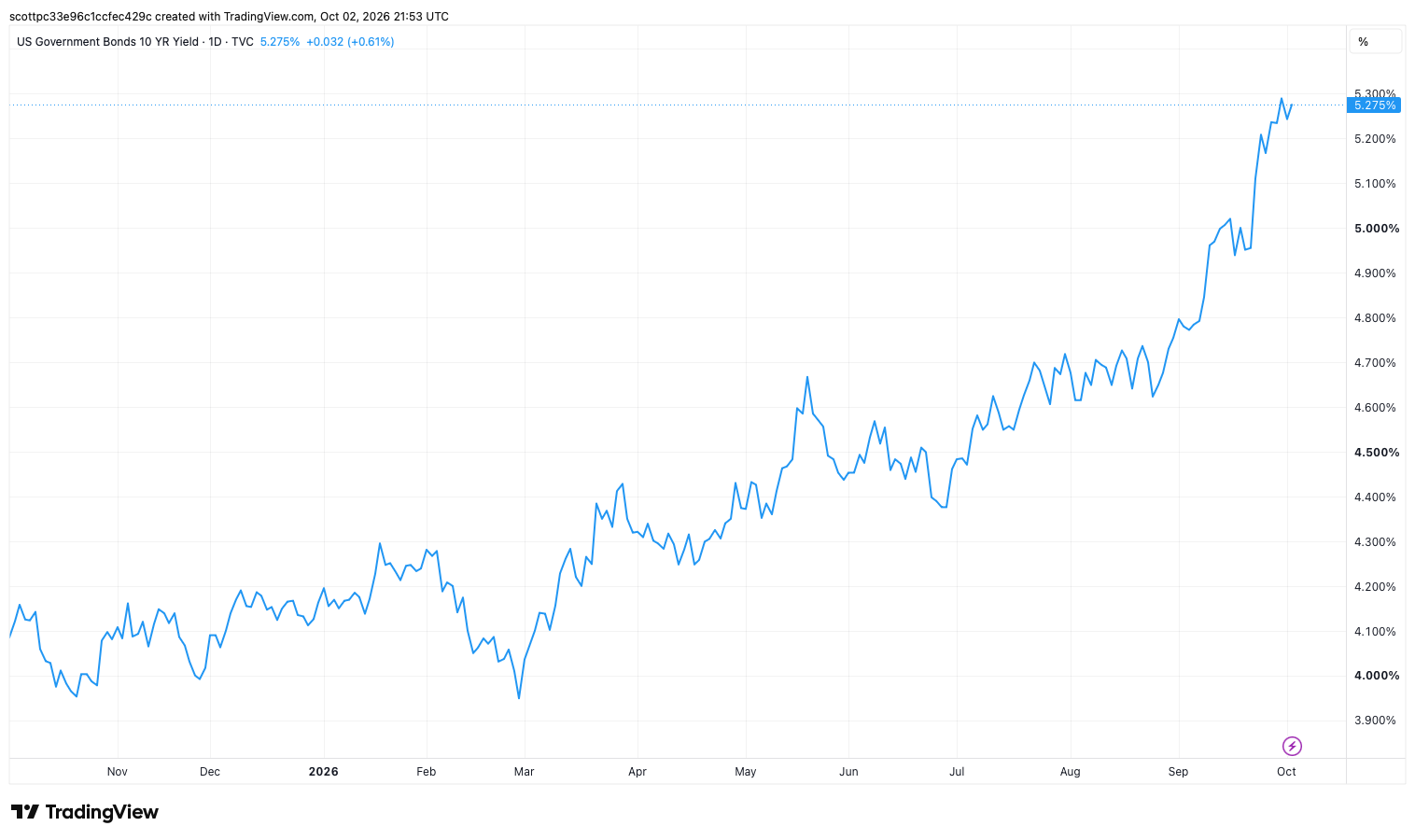
Resilient growth, heavy government borrowing, and the capital demands of the AI buildout are frequently cited as drivers of higher yields. Those forces may contribute, but in my view, the war’s effect on energy prices and inflation is the primary catalyst behind the recent move. Notably, the pressure is global: government bond yields have also risen in the United Kingdom, Germany, and Japan, a pattern consistent with an energy shock affecting economies worldwide.
Although oil flows through the Strait of Hormuz appear to have improved in recent weeks, the economic disruption is far from over. Energy analyst Rory Johnston estimated transport costs at $30–40-plus per barrel, excluding U.S. military costs. These costs add to inflationary pressure at a time when central banks have limited tools to address the underlying supply problem. As Jeff Currie and James Gutman of Carlyle wrote, “you can’t print molecules.” The Federal Reserve can raise interest rates to restrain demand, but it cannot produce more oil or secure the Strait of Hormuz.3,4
I don’t see a quick or easy resolution to the war on the horizon. The Associated Press reported that roughly 9,000 additional U.S. sailors and Marines were heading to the Middle East, including a third aircraft carrier. President Trump also said expanded bombing of Iran after the November midterm elections was possible. Rather than easing in the months ahead, the pressure on energy prices could intensify.5
For households, the combination of higher energy costs and more expensive credit puts pressure on spending. Mortgage News Daily’s benchmark 30-year fixed mortgage rate reached 7.57% on October 2. Higher rates are also driving up the costs of auto loans, credit cards, HELOCs, and other forms of consumer credit.6
A Treasury yield near 5% is not extraordinary by historical standards. What concerns me is the speed of the adjustment. Rapid increases give borrowers little time to adapt to higher financing costs, while falling bond prices can impose substantial losses on investors and lenders. The failure of Silicon Valley Bank in 2023 demonstrated how dangerous that combination can become. The faster rates rise, the greater the risk of a dislocation somewhere in the financial system.
An Improved Opportunity Set in Fixed Income
For the first time in my career, I think longer-dated bonds are worth serious consideration. For much of the past 16 years, I viewed them as offering what Jim Grant has called “return-free risk,” with yields too low to adequately compensate for rising interest rates and inflation. With longer-term Treasury yields above 5%, that trade-off has become considerably more balanced.7
Higher starting yields provide more income and a greater cushion against further price declines. I am becoming more inclined to accept additional interest-rate risk through longer-dated bonds where the yield justifies it. However, rates have strong upward momentum right now, which argues for patience and a gradual approach to building these positions. Attractive yields do not mean rates have peaked, and further increases could bring additional price declines.
Treasury Inflation-Protected Securities (TIPS) stand out in particular. TIPS principal adjusts with changes in the Consumer Price Index (CPI), and interest payments rise or fall with that adjusted principal. At quarter-end, the 10-year real yield was 2.93%, meaning an individual TIPS bought at that yield and held to maturity would earn nearly 3% per year above CPI inflation, before taxes.
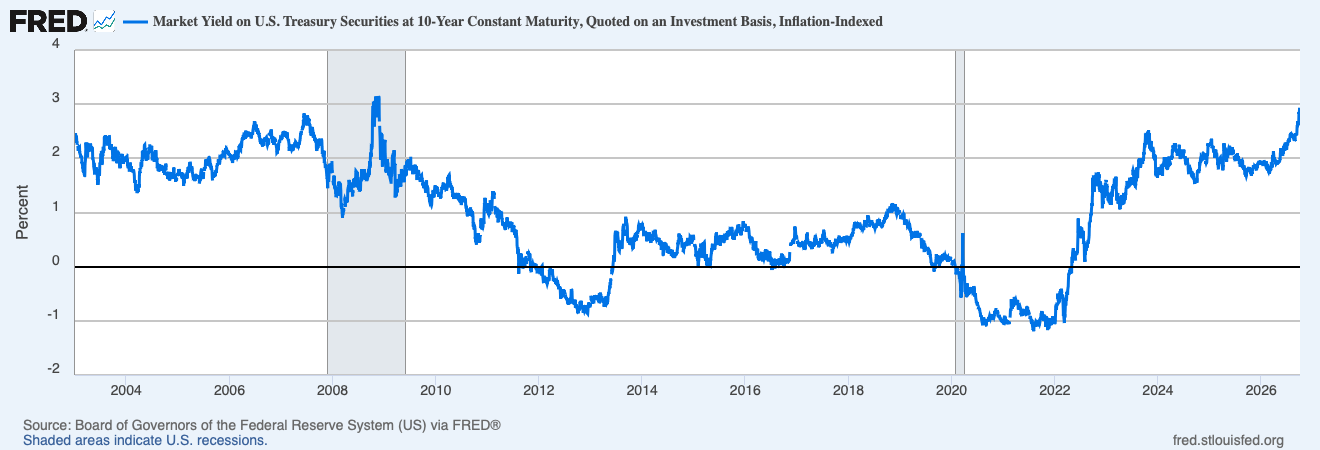
Only a few years ago, investors were accepting negative real yields in exchange for inflation protection. At current levels, TIPS are among the most compelling opportunities I see for investors seeking to protect and grow their purchasing power.
Agency mortgage-backed securities (MBS) are also attractive. Their yields have risen alongside Treasury rates, and their spread over Treasuries, the extra yield they pay compared with Treasuries, has widened as well. At quarter-end, the nominal spread on 30-year current-coupon agency MBS was approximately 1.25 percentage points over an equal blend of 5- and 10-year Treasuries, a meaningful income advantage on top of Treasury yields that are already more appealing.8
The main trade-off is that homeowners can refinance when rates fall, returning investors’ principal just when reinvesting it pays less. However, many homeowners locked in exceptionally low rates during the pandemic, and rates would need to fall substantially before refinancing made sense for them. That reduces the immediate refinancing risk in older mortgage pools and adds to their appeal.
The Scale of the AI Buildout
The other major force shaping markets is the enormous investment program underway at the largest cloud and technology companies, commonly referred to as hyperscalers. Amazon, Alphabet, Microsoft, Meta, and Oracle are buying chips, building data centers, and securing power on a scale that would have seemed implausible only a few years ago.
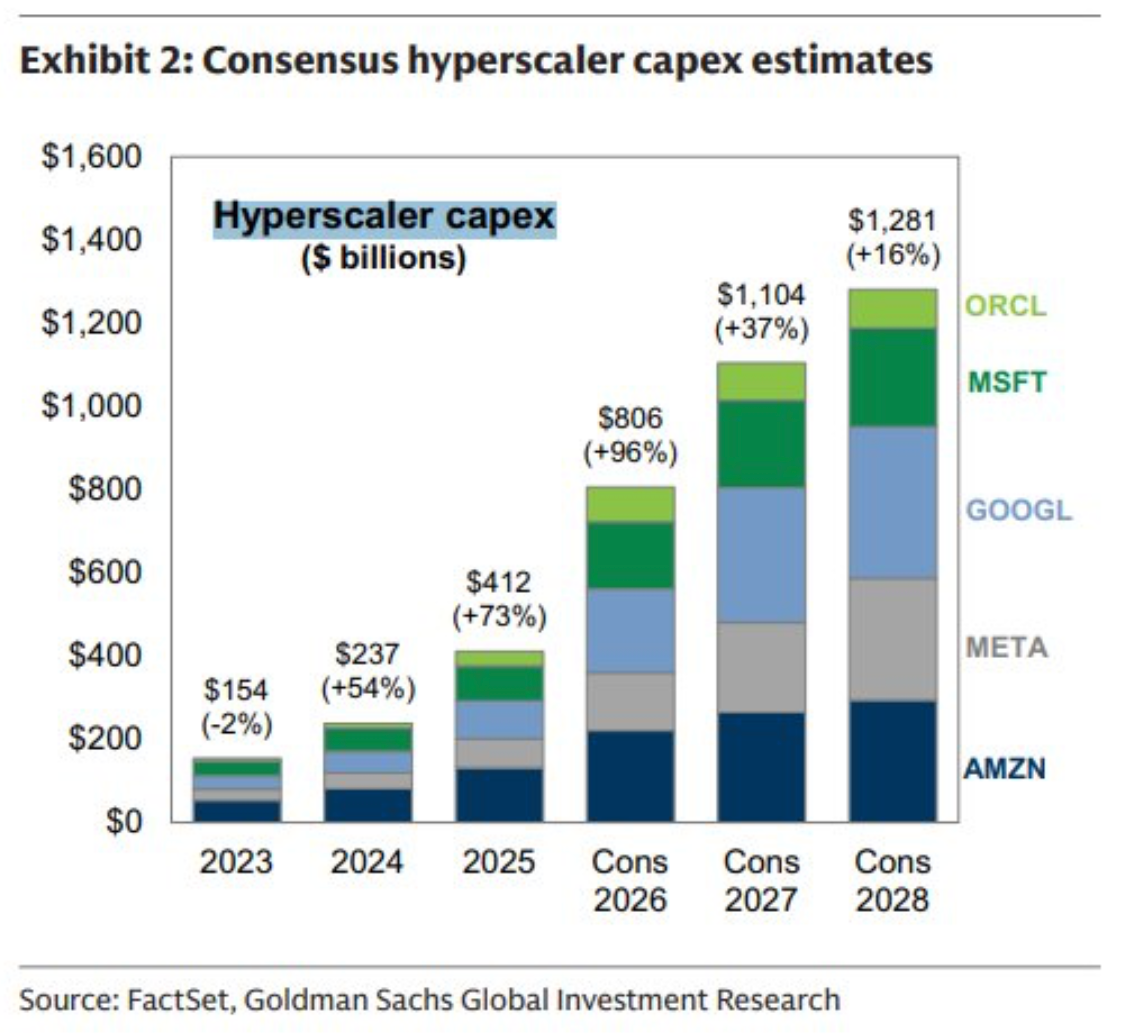
When I highlighted this spending in my Q1 letter, estimates called for $716 billion in capital expenditures in 2026 and $885 billion in 2027. Those expectations have since risen substantially. As the next figure shows, consensus estimates now place spending by these five companies at $806 billion this year and approximately $1.1 trillion in 2027, compared with $412 billion in 2025. That implies spending will nearly double this year, followed by a further 37% increase next year.
To put the broader AI buildout in historical context, the following chart compares projected AI investment with earlier booms in canals, railroads, electrification, highways, and telecommunications. Under these estimates, AI infrastructure spending would average roughly 3.6% of GDP annually from 2025 through 2032, exceeding each of those earlier buildouts relative to the size of the economy.
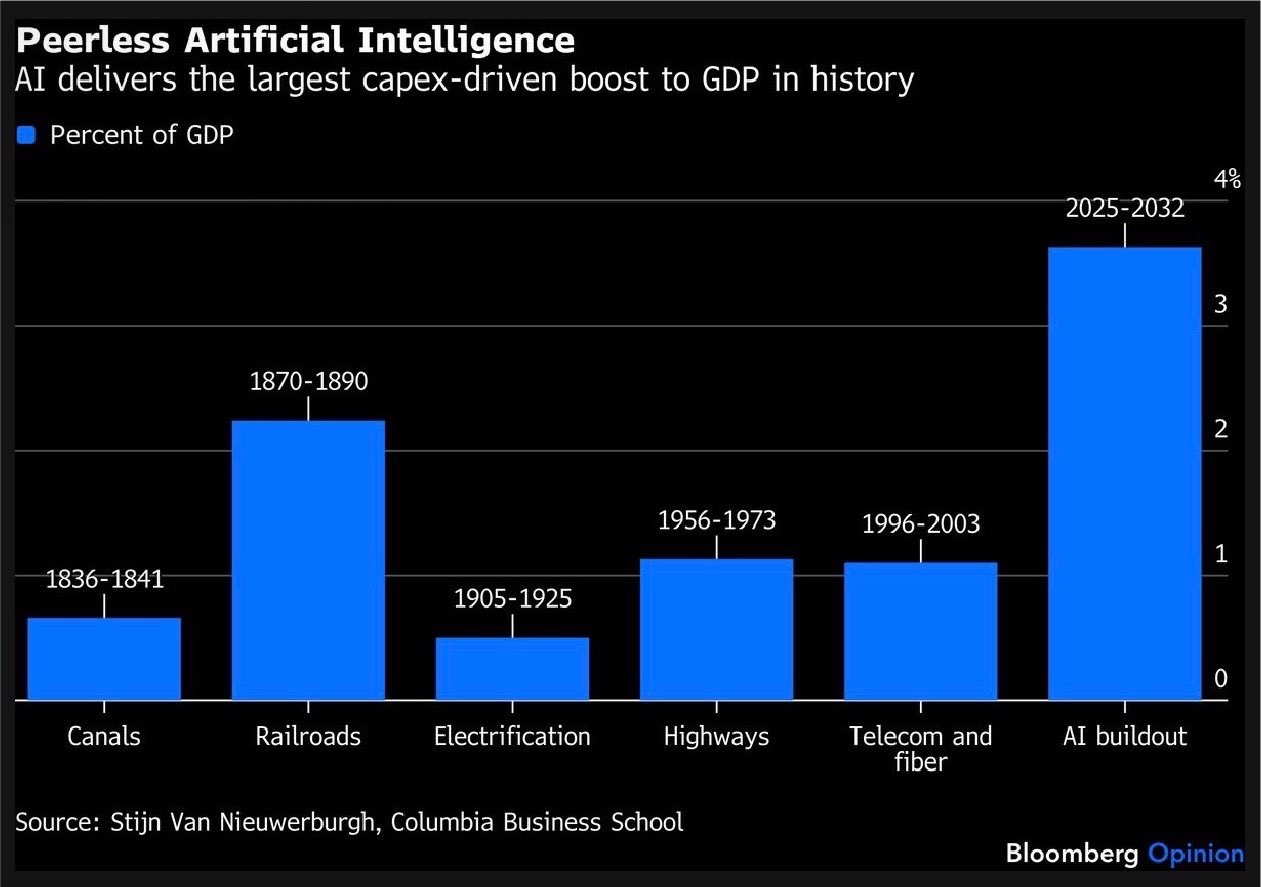
Whether all of that investment ultimately materializes remains to be seen. However, the companies leading the buildout appear to regard falling behind in AI as an existential threat. Alphabet CEO Sundar Pichai captured that mindset in 2024 when he said the “risk of underinvesting is dramatically greater than the risk of overinvesting.” I doubt a modest increase in borrowing costs will persuade these companies to pull back spending when they believe their future competitive position is at stake.9
The scale of this spending raises an important question: how much do economic growth and corporate earnings depend on these investments continuing to expand?
Economic and Earnings Impact of AI Investment
Hyperscaler spending becomes revenue for chipmakers, equipment manufacturers, construction companies, and engineering firms, supporting employment and incomes and generating profits throughout the supply chain.
AI’s impact on the construction world is particularly striking. As the next chart shows, data center construction has continued to expand even as other private construction spending has declined sharply:
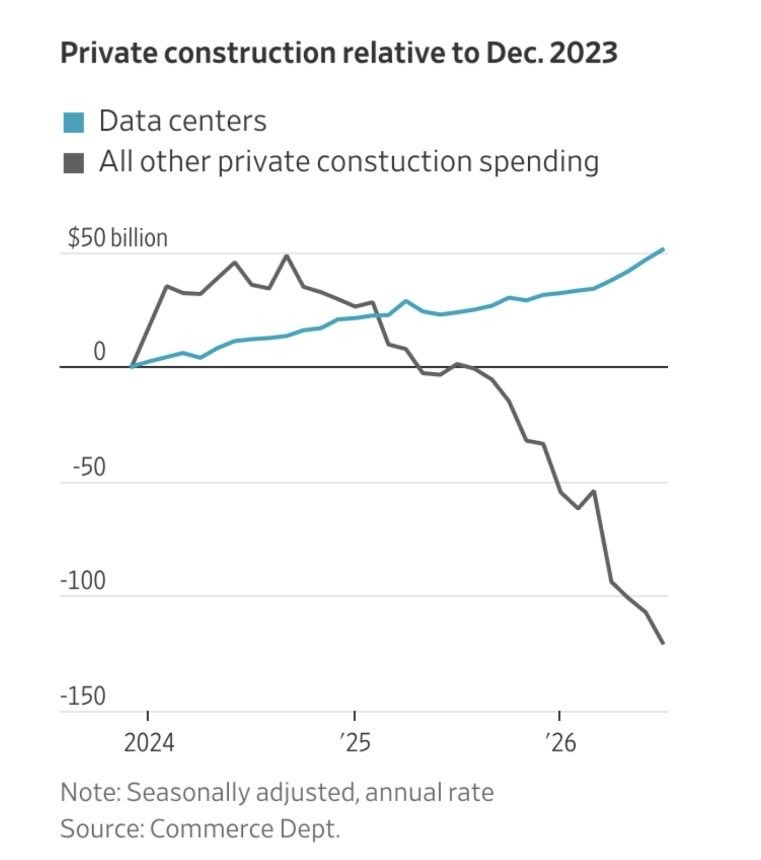
The impact on corporate profits is equally significant. Suppliers of scarce chips and equipment have benefited from both surging sales and strong pricing power. In their most recently reported quarters, Nvidia posted a gross margin of approximately 75% and Micron 87%. In effect, a substantial share of hyperscaler spending is being realized today as profit at other firms.10
Accounting conventions help explain why this spending provides such a powerful boost to reported earnings during the buildout phase. When a hyperscaler purchases equipment, it generally records an asset and recognizes the expense over the equipment’s useful life through depreciation. For illustration, a $1 billion equipment purchase depreciated evenly over six years generates approximately $167 million of annual depreciation once placed in service. The supplier, by contrast, can recognize the sale and associated profit much sooner: at a 75% gross margin, $1 billion of sales produces $750 million of gross profit.
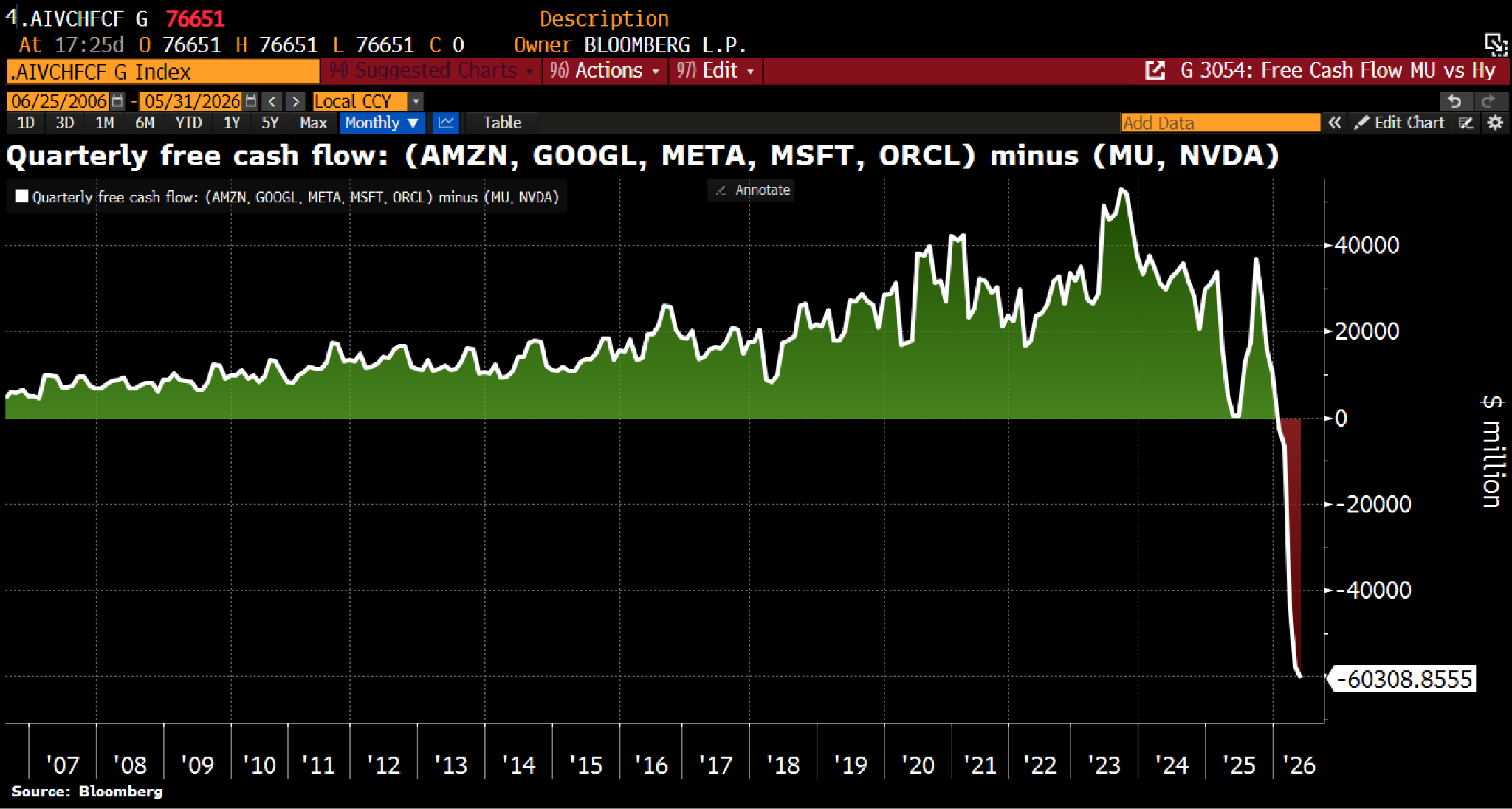
Three of the five major hyperscalers, Amazon, Alphabet, and Oracle, generated negative free cash flow in their latest reported quarters, while earnings and cash flow have surged at suppliers such as Nvidia and Micron. The companies supplying AI infrastructure are collecting cash today, while those paying for it are committing enormous sums in anticipation of future returns. Even these highly profitable hyperscalers are finding that their investment ambitions exceed the cash their operations generate.
Funding the Buildout: Growing Complexity
Hyperscalers initially funded much of their AI investment from the substantial cash flows generated by their existing businesses. Increasingly, they are turning to outside capital to sustain the buildout. Alphabet issued nearly $52 billion of bonds in the first half of 2026 and raised another $10 billion by selling newly issued shares to a Berkshire Hathaway affiliate. Meta issued $25 billion of bonds in May, while Oracle completed its $20 billion common stock sale program.11,12,13
As a result, further growth in spending is increasingly dependent on capital markets remaining receptive. Higher borrowing costs and shareholder dilution make it progressively more difficult to finance expansion unless AI ultimately generates more cash.
Certain financing structures also bring back uncomfortable memories of earlier investment bubbles. Companies are using special-purpose vehicles, separate entities formed to own or finance particular projects, to fund infrastructure without bringing all of the associated debt onto their own balance sheets. In September, Steve Eisman, known for his role in The Big Short, said the return of off-balance-sheet AI financing should give those who lived through Enron and the global financial crisis the “same queasy feeling we had back then.”14
Meta’s Hyperion data center venture illustrates the concern. Meta owns just 20%, but disclosed approximately $46 billion of maximum exposure through its investment, leases, funding commitments, and a guarantee that can require it to cover a shortfall in the property’s value if it terminates or does not renew its leases. Because Meta accounts for the venture as a separate investment rather than consolidating it, the venture’s assets and debt are not reported alongside Meta’s own. The full $46 billion of potential exposure therefore does not appear as debt on Meta’s balance sheet.12
Other commitments warrant similar scrutiny. Alphabet disclosed nearly $44 billion of maximum potential payments under data center backstops, with the related credit derivative liabilities recorded at a fair value of $815 million. Oracle disclosed $288 billion of additional lease commitments, largely for data centers, that had not yet commenced and therefore were not yet reflected as lease liabilities on its balance sheet. These arrangements have different triggers and accounting treatments, but each illustrates why reported debt alone provides an incomplete picture of financial exposure.11,13
These arrangements may comply with accounting rules, but they make it more difficult for investors to assess the full extent of the hyperscalers’ debt and financial commitments. Understanding the exposure requires piecing together borrowings, leases, guarantees, and funding obligations scattered across financial statement footnotes and separate entities. My concern is that investors may underestimate how much these companies have committed to spending and how little flexibility they could have if AI revenues disappoint or financing becomes harder to obtain. Moving an obligation off the balance sheet does not eliminate its potential cash demands.
Conclusion
The AI spending boom should continue supporting economic growth and corporate earnings as long as investment keeps expanding. But if that spending stalls or reverses, an important source of growth could become a major headwind. Suppliers would face stagnant or declining sales, while the companies funding the buildout would continue recording depreciation expenses and paying power bills, lease payments, and interest.
The competitive pressure to keep spending remains intense, but growing reliance on debt, equity issuance, and complicated financing structures shows that even these businesses face financial limits. I am monitoring both the pace of investment and the obligations accumulating behind it. AI can become valuable without every investment in its infrastructure earning an attractive return.
In fixed income, higher rates are creating compelling opportunities. I find current yields on longer-dated Treasuries, TIPS, and agency MBS increasingly attractive, with TIPS standing out for their combination of inflation protection and meaningful real yields. With rates still moving higher, I favor phasing into these positions over time.
Scott Caufield, CFA, CPA
October 6, 2026
Sources and data notes
Market returns and quoted quarter-end yields are through September 30, 2026. Other observations are dated in the text.
1. Market returns. ICE U.S. Treasury 20+ Year Bond Index, quarterly return via NEOS Investments, TLTI fund pages, September 30, 2026. 20+ year Treasuries
2. Treasury yields. Federal Reserve Board via FRED, DGS10; September 30 observation: 5.29%. FRED DGS10
3. Oil transportation. Fortune, September 26, 2026. Report
4. Energy and monetary policy. Jeff Currie and James Gutman, Carlyle, You can’t print molecules. Carlyle commentary
5. Associated Press, “Third aircraft carrier and thousands of troops head to Mideast as Trump weighs new Iran strikes,” October 1, 2026.
6. Mortgage rate. Mortgage News Daily, daily index for October 2, 2026: 7.57% for a top-tier 30-year fixed mortgage scenario. Individual borrower rates vary. MND rate index
7. Return-free risk. Grant’s Interest Rate Observer, December 2008 discussion of government bond yields. The phrase is attributed here as one Grant used, not one he necessarily coined. Grant’s article
8. Agency mortgage spread. AGNC, September 2026 Monthly Macro Monitor, 30-year current-coupon agency MBS nominal yield spread to a 50/50 blend of five- and ten-year Treasuries. The spread is not option-adjusted. AGNC report
9. Management’s investment rationale. Alphabet, Q2 2024 earnings call, Sundar Pichai’s response to Ross Sandler on investment risk and capital spending. Alphabet transcript
10. Chipmaker margins. Nvidia, Q2 fiscal 2027 results (quarter ended July 26, 2026): GAAP and non-GAAP gross margin 75.0%. Micron, Q4 fiscal 2026 results (quarter ended September 3, 2026): GAAP gross margin 86.8%, non-GAAP 87.0%. Nvidia release · Micron release
11. Alphabet financing. Alphabet, June 30, 2026 Form 10-Q, financing discussion and Notes 3, 5, 6 and 11. Backstop maximum exposure is contingent; the derivative liability is measured at fair value. Alphabet filing
12. Meta financing. Meta, June 30, 2026 Form 10-Q, Notes 5 and 8. Maximum venture exposure is not a current debt balance or expected loss. Meta filing
13. Oracle financing. Oracle, August 31, 2026 Form 10-Q, Notes 6 and 7. Future lease commitments are undiscounted contractual payments, not a present-value debt balance. Oracle filing
14. Steve Eisman. The Real Eisman Playbook, Weekly Wrap released September 25, 2026. The historical comparison is Eisman’s opinion. Episode and introduction
