What Social Security Benefit Puts You in the Top 10%?
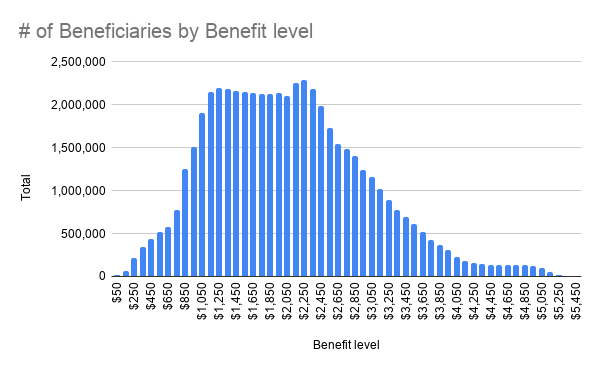
A Social Security retirement benefit of about $3,300 a month puts you in the top 10% of retired workers, based on the Social Security Administration’s December 2025 data. That works out to $39,600 a year for one person, before taxes and any Medicare premiums deducted from the payment. Source: SSA benefit distribution, Table 5.B6
A benefit that size could cover a substantial portion of your regular expenses and reduce the amount you need to withdraw from investments. But how much would you have needed to earn to get there?
The answer changes quite a bit depending on when you claim. In the examples below, claiming at 67 requires average annual wage-indexed earnings of about $99,000. Waiting until 70 brings that figure down to about $71,800.
Let’s look at where those numbers come from and what they mean if you’re approaching retirement.
How much do you need to earn for $3,300 a month from Social Security?
Here is the comparison using the benefit formula for someone turning 62 in 2026, whose full retirement age is 67:
| Calculation | Claim at 67 | Claim at 70 |
|---|---|---|
| Average indexed monthly earnings (AIME) | $8,246 | $5,986 |
| Average annual indexed earnings over 35 years | $98,952 | $71,832 |
| Full retirement age benefit (PIA) | $3,300.10 | $2,661.40 |
| Claiming-age multiplier | 100% | 124% |
| Resulting monthly payment, rounded down to whole dollars | $3,300 | $3,300 |
These illustrations exclude future cost-of-living adjustments and assume the earnings record is already in place. They do not predict the top-10% threshold when this person reaches 67 or 70.
These annual earnings figures are career averages after wage indexing. They are not the salary you must earn today or the amount you needed to earn in every individual year.
You could have earned substantially less early in your career and more later on. Social Security adjusts earlier earnings for changes in national wages before calculating the average.
How does the top 10% compare with the average benefit?
In SSA’s December 2025 table, the average retired-worker benefit was $2,071.30 a month. About 5.36 million of the 53.62 million retired workers in the table received $3,300 or more—almost exactly 10%. Source: SSA Table 5.B6
This comparison covers individual retired-worker benefits across ages, rather than household income or only people retiring that year. The published amounts are grouped into ranges, so $3,300 is a practical approximation of the 90th-percentile cutoff. Benefits and the population receiving them change over time.
How Social Security calculates your retirement benefit
Your benefit depends on your earnings history and the age you start collecting. Understanding the calculation helps explain why two people with similar salaries today can receive different amounts.
Your 35 highest earning years determine AIME
Social Security generally selects your 35 highest years of covered earnings after adjusting earlier years for wage growth. It adds those amounts together and divides by 420—the number of months in 35 years—to calculate your average indexed monthly earnings, or AIME.
If you have fewer than 35 years, missing years generally count as zeros. If you work longer, a higher earning year can replace a lower year in the calculation. AIME is rounded down to a whole dollar. Source: SSA benefit calculation
For someone turning 62 in 2026, earnings before 2024 are adjusted to the national average wage level in 2024. Earnings in 2024 and later are counted at face value. Only earnings covered by Social Security, subject to each year’s limit, enter the calculation. Source: SSA wage indexing
This is why comparing a historical salary directly with the $99,000 figure above can be misleading. You wouldn’t have needed to earn $99,000 in the 1990s for those years to make a meaningful contribution.
Bend points determine how much of those earnings is replaced
Social Security uses a progressive formula, replacing a larger percentage of the first portion of your earnings and smaller percentages of additional earnings. The dollar thresholds where those percentages change are called bend points.
For someone first eligible for retirement benefits in 2026, the formula is:
- 90% of the first $1,286 of AIME.
- 32% of AIME above $1,286 through $7,749.
- 15% of AIME above $7,749.
Add the three benefit amounts together to get the primary insurance amount, or PIA, before subsequent adjustments. PIA is the starting point for your full retirement age benefit. The applicable bend points are determined by the year you turn 62, even if you claim later. Source: SSA primary insurance amount formula

Getting a $3,300 Social Security benefit at age 67
Using AIME of $8,246, the calculation looks like this:
| Portion of average monthly earnings | Replacement rate | Monthly benefit generated |
|---|---|---|
| First $1,286 | 90% | $1,157.40 |
| Next $6,463 | 32% | $2,068.16 |
| Remaining $497 | 15% | $74.55 |
| Total before rounding | $3,300.11 |
SSA rounds the PIA down to the next lower dime, giving $3,300.10. The monthly payment rounds down to $3,300 in this illustration.
To express the earnings requirement annually, multiply $8,246 by 12. That gives $98,952, or about $99,000 a year, averaged over the highest 35 years after the applicable wage adjustments.
That is a good income, but it does not require a career spent earning the maximum amount subject to Social Security taxes.
Getting the same benefit by waiting until age 70
For someone whose full retirement age is 67, waiting until 70 raises the benefit to 124% of PIA, before considering cost-of-living adjustments. Source: SSA delayed retirement benefits
To reach a $3,300 payment, the required PIA is therefore approximately:
$3,300 ÷ 1.24 = $2,661.29
An AIME of $5,986 produces a slightly higher PIA of $2,661.40:
- $1,286 × 90% = $1,157.40.
- $4,700 × 32% = $1,504.00.
- Total: $2,661.40.
Multiply that by 1.24 and the result is approximately $3,300 a month. Annualized, $5,986 of AIME equals $71,832 of average indexed earnings.
I think this is the most interesting part of the comparison. Waiting three years reduces the required average annual indexed earnings by $27,120 in these examples.
You do not have to keep working until 70 to earn delayed retirement credits. You can stop working earlier and wait to claim, provided you have another way to cover your expenses. Additional work could further increase your benefit if it replaces lower earnings in your record.
Can you receive $3,300 a month if you claim at 62?
With a full retirement age of 67, starting at 62 reduces your retirement benefit by 30%. You receive 70% of PIA. Source: SSA early retirement factors
A $3,300 payment would therefore require a PIA of approximately $4,714.29 before the reduction.
For perspective, SSA’s published maximum-earner example for a person claiming at 62 in 2026 is $2,969 a month. That example assumes earnings at the taxable maximum every year beginning at age 22. It falls $331 below our target. Source: SSA maximum benefit examples
The comparison is specific to 2026. It should not be read as a permanent dollar ceiling for everyone claiming at 62 in future years. What it illustrates is how much an early start can reduce the monthly payment, even after a career of high earnings.
Check the assumptions on your Social Security statement
Your own statement is the best place to start comparing potential benefits. Pay attention to the future earnings assumption: estimates generally project continued earnings based on your recent record. Source: SSA statement methodology
If you plan to retire at 60 but claim at 67, make sure the estimate reflects those years without employment income. Otherwise, it may include additional earnings you don’t expect to have.
Also review your earnings history for missing or incorrect amounts, and check whether the estimate is expressed in today’s dollars or future dollars. That distinction matters when comparing it with a benchmark from a particular year.
What does a top-10% benefit mean for your retirement plan?
A $3,300 monthly benefit is valuable, but the amount you need depends on your spending and other income.
Suppose your household expects $10,000 a month in total outflows, including taxes and healthcare, and your combined gross Social Security benefits are $5,500. You would still need approximately $4,500 a month from investments, pensions, or other sources. Your own benefit could compare favorably with other retirees’ benefits while leaving a meaningful gap to fund.
That is where I would focus the planning discussion. How much will you need from savings? How does that change if you retire before starting Social Security? Would delaying benefits require withdrawals you are comfortable making?
Waiting also means giving up payments you could have received sooner. Health, longevity, available savings, and the needs of a spouse all deserve consideration. A higher monthly payment is one part of the decision.
At Sophos Wealth Management, I help people approaching retirement bring their Social Security decisions, investment strategy, and tax planning together. The goal is to understand how those choices affect the retirement you want.
Interested in working together? Schedule a free introductory call.
If you’re still organizing your plans, my Ultimate Retirement Checklist is another place to start.